
Why workplace wellbeing is failing — and what actually works
A white paper on the In Rose Framework: rest, regulation and reflection — evidence-based, inclusive workplace support that is embedded and measurable.
Most organisations are already paying for poor workplace wellbeing. They just aren’t calling it that. Workplace health costs UK employers an estimated £85 billion a year — including £47 billion in lost output, £21 billion from presenteeism and £10 billion in sick pay (UK Government, Keep Britain Working Review 2026).
Employers are spending more on wellbeing provision than ever before — and getting less back. Apps go unused. EAP uptake remains stubbornly low. Retreats provide short-lived relief. Yoga classes attract the already-well. The problem is not a shortage of wellbeing products. It is the absence of embedded, inclusive, measurable support that fits how high-cognitive-load professionals actually work.
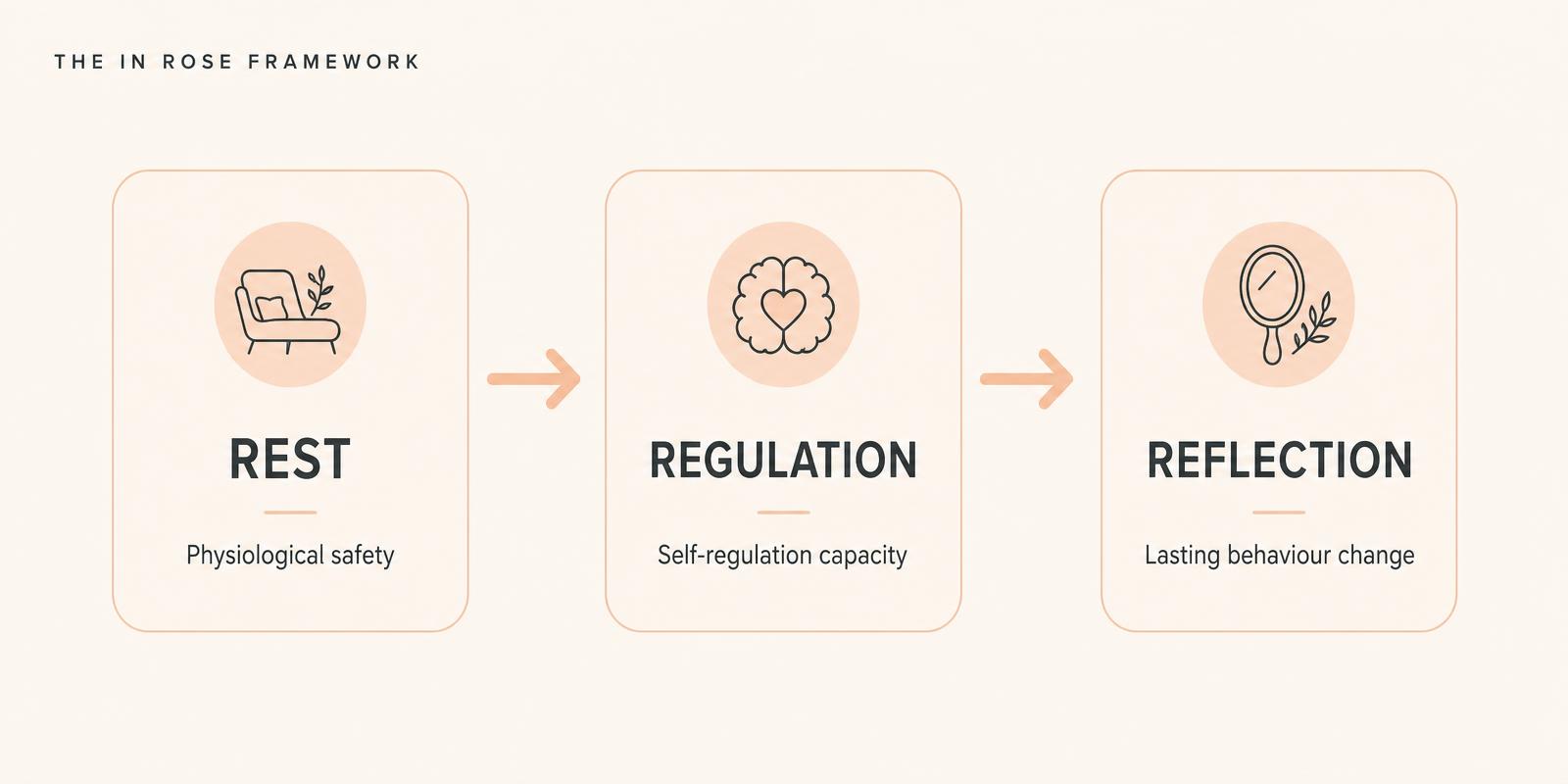
This white paper introduces the In Rose Framework — Rest, Regulation and Reflection — a workplace wellbeing methodology developed by in rose clinic, informed by almost a decade of NHS mental health and employment experience including senior-level practice, and 8 years of mindfulness facilitation.
It is grounded in direct work with individuals and organisations across London & Berkshire, where first-hand experience has highlighted the human and organisational cost of inadequate support for workplace wellbeing — prolonged stress, disengagement, absence and crisis. The In Rose Framework provides the evidence-aligned arc from physiological safety through self-regulation capacity to lasting behaviour change: the missing bridge between wellness activity and measurable organisational outcomes.
£85bn
annual UK employer cost of workplace health (Keep Britain Working Review, 2026)
964,000
workers reporting work-related stress, depression or anxiety (HSE, 2024/25)
22.1m
working days lost — 22.9 days per case (HSE, 2024/25)
£5.60
estimated return per £1 invested in early intervention (Deloitte)
Part 1 — Why existing provision is failing
1.1 The scale of the challenge
In 2024/25, 964,000 workers reported work-related stress, depression or anxiety, contributing to 22.1 million working days lost — an average of 22.9 days per case (HSE, 2024/25). The rate is statistically significantly higher than the previous year.
These figures highlight that workplace stress is not simply an individual wellbeing issue. It has measurable consequences for health, absence, capacity and organisational performance. For employers, the focus therefore needs to extend beyond responding to burnout and absence towards creating working environments that help their people recognise stress earlier, maintain capacity and access meaningful support before difficulties escalate.
Despite growing investment in wellbeing initiatives, only half of organisations believe their attempts to reduce workplace stress are effective. Employees continue to report high workloads, exhaustion and declining mental wellbeing — suggesting the challenge is not a lack of wellbeing activity, but a lack of wellbeing approaches that are embedded, inclusive and capable of creating lasting change.
The gap between investment and impact is not an accident. It is structural.
1.2 The organisations with nothing at all
Before examining existing wellbeing provision, it is worth naming a starker reality: for a significant number of organisations, there is no provision at all. No budget. No programme. No designated support. In these environments, the absence of investment does not mean the absence of cost — it means the cost is being carried entirely by individuals and absorbed invisibly by the organisation.
Chronic stress left unaddressed becomes burnout. Burnout becomes absence. Absence becomes attrition. Attrition becomes a recruitment crisis. At each stage, the financial and human cost escalates — and at each stage, it could have been interrupted.
Organisations without any wellbeing investment are not avoiding the problem. They are funding its most expensive version.
1.3 The structural failures of current provision
| Current provision | Structural failure |
|---|---|
| EAPs and one-off webinars | Reactive, under-promoted, low trust; don't address day-to-day regulation or team norms |
| Generic mindfulness apps | Self-serving; no shared culture change, accountability or inclusion; engagement drops sharply post-onboarding |
| Ad-hoc yoga / meditation classes | Event-based; not integrated into high-pressure workflows; limited behaviour change |
| One-off retreats / offsites | Short-lived benefits without continuity; often not inclusive or psychologically safe for all |
| Individual therapy (NHS / private) | Important for clinical issues but not a workplace system solution; access, wait times and stigma limit use |
| Peer / internal mental health first aiders | Lack professional facilitation, structure and safety; risk of boundary violations and secondary trauma |
| Corporate wellbeing platforms | High-brand, self-serve digital tools; no clinical depth, no facilitation, no inclusion by design; no behaviour change at team or organisational level |
EAPs and one-off webinars
- Structural failure
- Reactive, under-promoted, low trust; don't address day-to-day regulation or team norms
Generic mindfulness apps
- Structural failure
- Self-serving; no shared culture change, accountability or inclusion; engagement drops sharply post-onboarding
Ad-hoc yoga / meditation classes
- Structural failure
- Event-based; not integrated into high-pressure workflows; limited behaviour change
One-off retreats / offsites
- Structural failure
- Short-lived benefits without continuity; often not inclusive or psychologically safe for all
Individual therapy (NHS / private)
- Structural failure
- Important for clinical issues but not a workplace system solution; access, wait times and stigma limit use
Peer / internal mental health first aiders
- Structural failure
- Lack professional facilitation, structure and safety; risk of boundary violations and secondary trauma
Corporate wellbeing platforms
- Structural failure
- High-brand, self-serve digital tools; no clinical depth, no facilitation, no inclusion by design; no behaviour change at team or organisational level
The common thread: existing provision is either reactive, event-based, self-serve or clinically focused — none is simultaneously embedded, inclusive, facilitated and measurable.
1.4 The inclusion gap nobody is addressing as norm
Approximately 15–20% of the UK population is neurodivergent — yet most workplace wellbeing provision actively excludes them through:
- Overstimulating environments and formats
- Culturally misaligned facilitation styles
- Lack of sensory or pace adjustments
- Assumption of neurotypical processing and communication norms
Neurodivergent employees are 3x more likely to mask at work (Neurodiversity in Business, 2023) — expending significant cognitive and emotional energy on concealment rather than contribution. Non-inclusive wellbeing provision does not just fail to help these employees; it actively excludes them from the support they need most.
The same structural exclusion affects underrepresented groups more broadly. Culturally responsive, trauma-informed provision is not a nice-to-have — it is the difference between provision that works and provision that widens existing inequities.
Part 2 — The In Rose Framework
The In Rose Framework — Rest, Regulation and Reflection — is in rose clinic’s workplace wellbeing methodology. Developed through nearly a decade of NHS mental health employment and job retention practice up to senior level, 8 years of mindfulness facilitation, and grounded in evidence from neuroscience, mindfulness research, somatic psychology and occupational health, it provides a coherent three-stage arc — the missing bridge between “wellness activity” and measurable organisational outcomes.
Stage 1 — Rest
The physiological foundation. Most wellbeing interventions skip this stage entirely — jumping straight to cognitive content before the nervous system is ready to receive it. Rest is not passivity; it is the active creation of physiological safety through:
- Guided breathwork — activating the parasympathetic nervous system to down-regulate the chronic stress response
- Trauma-informed body-based practices — understanding stress signals, somatic grounding, body scan techniques
- Sensory regulation — adjusting the environment to reduce overstimulation and create genuine safety, particularly for neurodivergent participants
- Micro-rest practices — interventions embedded into existing meetings and calendars
Why it matters: a nervous system in chronic stress cannot regulate, cannot reflect and cannot change behaviour. Rest is not a luxury — it is the prerequisite for everything that follows.
Grounded in: Polyvagal Theory (Porges), Somatic Experiencing (Levine), 300-hour Meditation Teacher Training (Shree Mahesh Heritage, 2017), Level 3 Fitness Management (NCFE, 2016).
Stage 2 — Regulation
Building the capacity to stay stable under pressure. Regulation is the development of emotional and cognitive self-regulation skills — the ability to first understand, then consciously learn to remain within the individual window of tolerance when pressure intensifies. This stage builds:
- Mindfulness-based skills — attention training, present-moment awareness, non-reactive observation
- Somatic awareness — recognising the body's early stress signals before they escalate
- Boundary-setting and load-shedding — practical skills for managing cognitive load and protecting recovery space
- Psychological safety tools — frameworks for managers to host regulation-supporting conversations with their teams
Why it matters: regulation is the difference between surviving a high-pressure role and thriving in one. Without regulation capacity, rest is temporary relief; with it, rest becomes a sustainable practice.
Grounded in: Mindfulness-Based Stress Reduction (MBSR), Mindfulness-Based Cognitive Therapy (MBCT), Mindfulness for Professionals qualification (British Mindfulness Academy, 2023), NHS mental health clinical experience.
Stage 3 — Reflection
Converting experience into insight and lasting behaviour change. Reflection is the stage where regulated experience becomes individual wisdom — what transforms a wellbeing intervention from an event into a lasting shift in how an individual or team functions:
- Guided reflective dialogue — structured conversation that surfaces insight and integrates learning
- Holistic health appointments — confidential 1:1 support combining reflective practice with a holistic health perspective
- Supportive tools — light-touch reflective tools that embed the practice over time
- Team reflective circles — group reflection formats that create shared language, shared norms and psychological safety at team level
Why it matters: without reflection, experience passes without learning. Reflection is what makes rest and regulation “stick” — converting short-term relief into permanent behaviour change and cultural shift.
Grounded in: Job Retention Case Management (Job Retention Network, 2021), NHS holistic health appointment practice, and 10 years of reflective practice with clients in high-cognitive-load roles.
Part 3 — How the framework is delivered
The In Rose Framework is not an event. It is an embedded, systemic intervention. The In Rose Workplace Programme delivers through five stages.
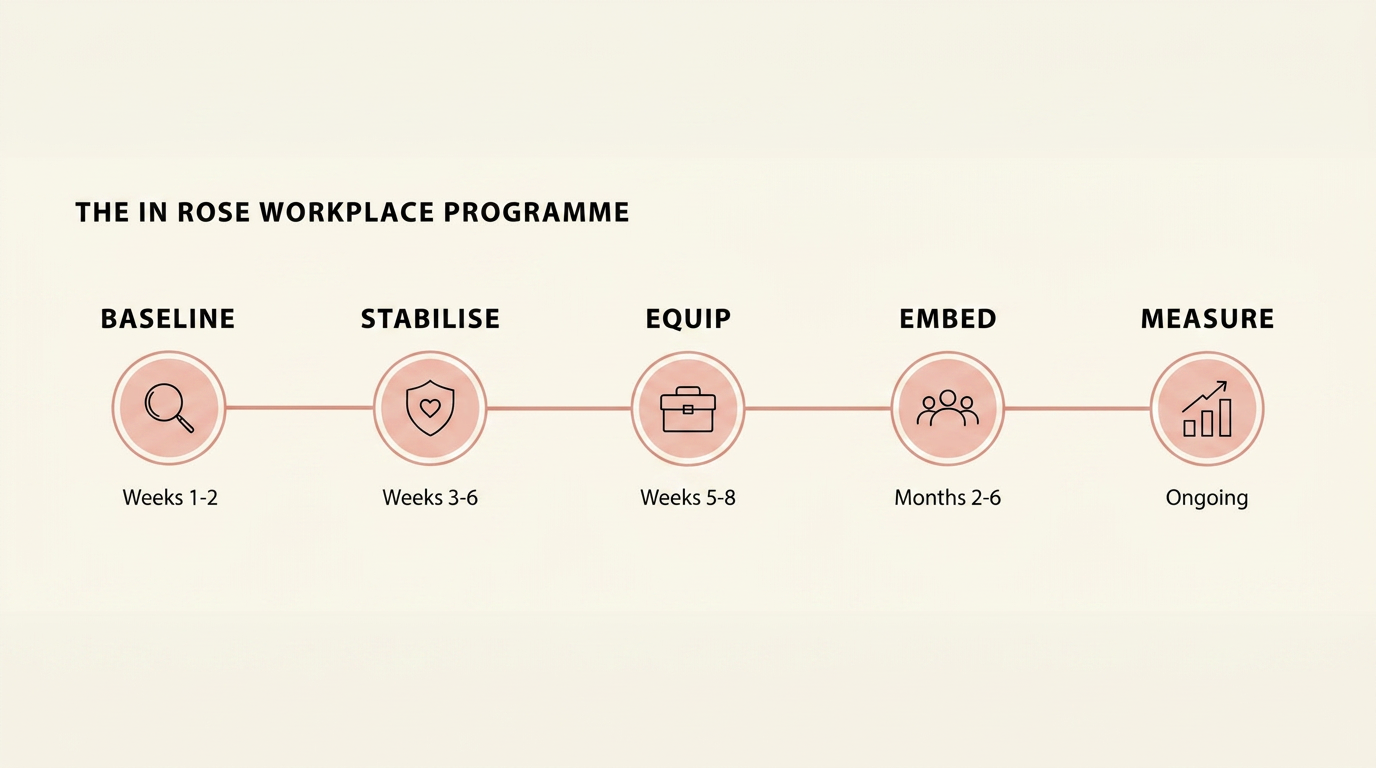
| Stage | What happens | Timeline |
|---|---|---|
| Baseline | Baseline assessment using validated measures (Adapted WEMWBS + Adapted PSS); stakeholder interviews to map cognitive load hotspots and inclusion barriers | Weeks 1–2 |
| Stabilise | In Rose starter series (60–90 min facilitated sessions); optional retreat day to reset nervous system load; optional confidential 1:1 holistic appointments for managers and leads | Weeks 3–6 |
| Equip | Develop psychological safety, boundary-setting, load-shedding, reflective questioning and team ritual templates | Weeks 5–8 |
| Embed | 5–7 minute regulation practices added to existing meetings; optional monthly reflective circles; inclusive facilitation guidelines for internal hosts | Months 2–6 |
| Measure | Outcome snapshots at start, midpoint and close using validated measures; team-safe insights shared with HR/People partners; iterative programme adjustments | Ongoing |
Baseline
- What happens
- Baseline assessment using validated measures (Adapted WEMWBS + Adapted PSS); stakeholder interviews to map cognitive load hotspots and inclusion barriers
- Timeline
- Weeks 1–2
Stabilise
- What happens
- In Rose starter series (60–90 min facilitated sessions); optional retreat day to reset nervous system load; optional confidential 1:1 holistic appointments for managers and leads
- Timeline
- Weeks 3–6
Equip
- What happens
- Develop psychological safety, boundary-setting, load-shedding, reflective questioning and team ritual templates
- Timeline
- Weeks 5–8
Embed
- What happens
- 5–7 minute regulation practices added to existing meetings; optional monthly reflective circles; inclusive facilitation guidelines for internal hosts
- Timeline
- Months 2–6
Measure
- What happens
- Outcome snapshots at start, midpoint and close using validated measures; team-safe insights shared with HR/People partners; iterative programme adjustments
- Timeline
- Ongoing
What makes this different
| Feature | Generic provision | In Rose Workplace Programme |
|---|---|---|
| Clinical depth | None | 10 years employment mental health practice (NHS) and 8 years mindfulness facilitation |
| Inclusive design | Assumed / bolt-on | Neurodiversity-affirming, trauma-informed, culturally responsive by design |
| Embedded delivery | Event-based | Integrated into existing meetings and calendars |
| Measurable outcomes | Anecdotal | Adapted PSS, Adapted WEMWBS, pre/mid/post comparisons, leadership-ready reporting |
| Whole-person approach | Single modality | Physical, psychological, somatic and reflective dimensions integrated |
| Systemic reach | Individual | Individual + team + organisational levels simultaneously |
Clinical depth
- Generic provision
- None
- In Rose Workplace Programme
- 10 years employment mental health practice (NHS) and 8 years mindfulness facilitation
Inclusive design
- Generic provision
- Assumed / bolt-on
- In Rose Workplace Programme
- Neurodiversity-affirming, trauma-informed, culturally responsive by design
Embedded delivery
- Generic provision
- Event-based
- In Rose Workplace Programme
- Integrated into existing meetings and calendars
Measurable outcomes
- Generic provision
- Anecdotal
- In Rose Workplace Programme
- Adapted PSS, Adapted WEMWBS, pre/mid/post comparisons, leadership-ready reporting
Whole-person approach
- Generic provision
- Single modality
- In Rose Workplace Programme
- Physical, psychological, somatic and reflective dimensions integrated
Systemic reach
- Generic provision
- Individual
- In Rose Workplace Programme
- Individual + team + organisational levels simultaneously
Part 4 — Outcome measurement
Our outcome measures are drawn from two widely-used, clinically validated tools: the Warwick–Edinburgh Mental Wellbeing Scale (WEMWBS) and the Perceived Stress Scale (PSS). Both are gold-standard instruments used in NHS settings, workplace wellbeing research and public health evaluation to track subjective wellbeing and perceived stress over time.
We have thoughtfully adapted both scales for the in rose clinic context — softening the clinical language, framing questions with warmth and choice, and ensuring they feel consistent with the inclusive, trauma-informed ethos of our programmes. The spirit and validity of each measure is preserved while the experience of completing them is made accessible and non-pathologising for all participants.
in rose clinic uses these validated, adapted measures taken at three points across every programme — start, midpoint and close — to evidence genuine arc-of-programme change without over-surveying participants. This captures both the objective shift in scores and the qualitative narrative of what changed.
| Measure | Source | What it captures | Taken |
|---|---|---|---|
| Subjective wellbeing | Adapted WEMWBS | How participants are feeling, functioning and flourishing | Start, midpoint & close |
| Perceived stress | Adapted PSS | How supported, resourced and in control participants feel at work — tracking positive shifts in capacity and confidence | Start, midpoint & close |
| Closing reflection | Qualitative feedback | Richer narrative of what shifted across the programme | Programme close |
| Leadership reflection | Facilitated debrief | Leadership perspective on cultural change and organisational impact | Programme close |
Subjective wellbeing
- Source
- Adapted WEMWBS
- What it captures
- How participants are feeling, functioning and flourishing
- Taken
- Start, midpoint & close
Perceived stress
- Source
- Adapted PSS
- What it captures
- How supported, resourced and in control participants feel at work — tracking positive shifts in capacity and confidence
- Taken
- Start, midpoint & close
Closing reflection
- Source
- Qualitative feedback
- What it captures
- Richer narrative of what shifted across the programme
- Taken
- Programme close
Leadership reflection
- Source
- Facilitated debrief
- What it captures
- Leadership perspective on cultural change and organisational impact
- Taken
- Programme close
Programme formats & durations
6-week starter pilot
A concentrated introduction to the framework — ideal for organisations wanting to test the approach before a longer commitment. Measures at weeks 1, 3 and 6.
12-week scale-up embed
Three phases: Foundation (weeks 1–4), Deepening (weeks 5–9), Integration (weeks 10–12). Twelve group sessions, with optional 1:1 holistic appointments. Measures at weeks 1, 6 and 12.
6 & 12-month embedded
A sustained partnership at individual, team and leadership level, with monthly HR/People consultation and a full In Rose Impact Report at close. Measures at months 1, 3 and 6.
Part 5 — The business case
The cost of inaction
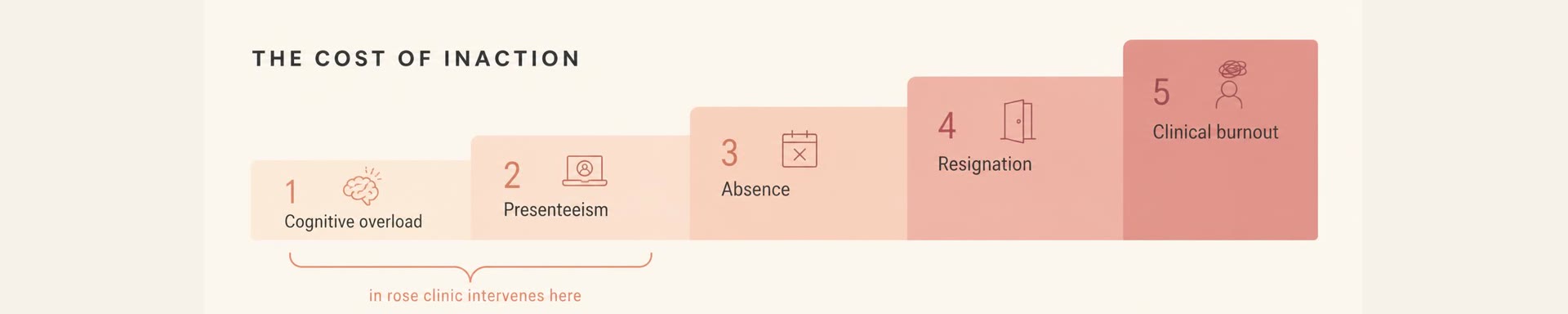
- Stage 1 — cognitive overload and reduced performance: invisible cost, untracked
- Stage 2 — presenteeism: physically present, mentally absent (£85bn UK employer cost annually, Keep Britain Working Review 2026)
- Stage 3 — absence and sick leave: 22.1 million lost working days (HSE, 2024/25)
- Stage 4 — resignation and replacement: average £30,000+ per senior hire (CIPD)
- Stage 5 — clinical burnout and reputational damage: irreversible in the short term
The ROI argument
- An estimated £5.60 return for every £1 invested in organisation-wide early mental health interventions, including awareness and cultural change (Deloitte)
- For an organisation of 100 people with average presenteeism costs, the In Rose programme pays for itself within the first quarter
- Reduced turnover in high-skill roles: replacing one senior employee costs 6–9 months of salary (CIPD); retaining one is a direct saving
- DEI outcomes: organisations with inclusive wellbeing provision demonstrate measurably better performance, retention and progression for underrepresented groups (CIPD, 2023)
Why this, why now
- Hybrid and remote work has blurred recovery boundaries permanently
- Cognitive load has intensified as digital communication has accelerated
- 22.1 million working days lost to work-related stress, depression or anxiety in Great Britain in 2024/25 (HSE)
- Talent expectations have shifted — wellbeing culture is now a candidate selection criterion
- Regulatory pressure on employer duty of care is increasing, with ISO 45003 setting an international benchmark for psychological safety at work
- The HSE is placing greater scrutiny on how organisations assess and manage work-related stress risk
- The Employment Rights Bill 2024 strengthens employee protections and raises the bar for employer accountability
- DEI commitments require measurable, inclusive wellbeing provision — not just stated intention
Organisations that invest in embedded, inclusive, measurable wellbeing now are building a competitive advantage that compounds. Those that wait are managing an escalating cost.
Part 6 — About in rose clinic
in rose clinic is a workplace wellbeing service helping busy organisations and professionals in London & Berkshire — through group and 1:1 support — to address stress, burnout and cognitive overload through an inclusive lens. We create spaces for rest, regulation and reflection through guided mindfulness, reflective holistic health appointments, workshops, workplace wellbeing programmes and retreats.
Founder credentials
| Qualification | Provider | Year |
|---|---|---|
| NHS Mental Health Employment & Job Retention Case Management, Senior & Advisor, 9 years | NHS & SMART London | 2026 |
| Job Retention Case Management, Advanced Legal Skills for EAs & The Skilled Helper | Job Retention Network | 2025 |
| Mindfulness for Professionals — 36-hour qualification | British Mindfulness Academy | 2023 |
| Meditation Teacher Training — 300-hour qualification | Shree Mahesh Heritage School | 2017 |
| Fitness Management — Level 3 Diploma | NCFE | 2016 |
| Mental Health First Aid | MHFA England® | 2020 |
| Event & Business Management | University of Chichester | 2011 |
NHS Mental Health Employment & Job Retention Case Management, Senior & Advisor, 9 years
- Provider
- NHS & SMART London
- Year
- 2026
Job Retention Case Management, Advanced Legal Skills for EAs & The Skilled Helper
- Provider
- Job Retention Network
- Year
- 2025
Mindfulness for Professionals — 36-hour qualification
- Provider
- British Mindfulness Academy
- Year
- 2023
Meditation Teacher Training — 300-hour qualification
- Provider
- Shree Mahesh Heritage School
- Year
- 2017
Fitness Management — Level 3 Diploma
- Provider
- NCFE
- Year
- 2016
Mental Health First Aid
- Provider
- MHFA England®
- Year
- 2020
Event & Business Management
- Provider
- University of Chichester
- Year
- 2011
in rose clinic is led by a practitioner who has spent over a decade supporting busy professionals, high-cognitive-load workers and individuals navigating employment challenges related to mental health — within NHS services, government employment programmes and local councils, following holistic health foundations. The In Rose Framework is the distillation of that experience, informed by 8 years of mindfulness practice and inclusive facilitation that is accessible across different neurotypes, identities, cultures and lived experiences.
Conclusion
Workplace wellbeing is not failing because employers don’t care. It is failing because the provision available is structurally inadequate — reactive, generic, event-based and non-inclusive.
Capacity is an individual experience; through repeated practice, the skills become learnt over time. We are not able to compare individuals, but we can measure outcomes through different means — and the In Rose Framework is built to do exactly that, across every programme format, at every level of the organisation.
The question is not simply whether to invest in wellbeing, but whether you are creating the conditions for people to thrive at work.
For those already investing: understand whether that investment is working and shifting culture. For those who are not: comprehend what the true cost of doing nothing is.
Sources
- UK Government, Keep Britain Working Review (2026)
- Health and Safety Executive, work-related stress, depression or anxiety statistics (2024/25)
- Deloitte, Mental health and employers — refreshing the case for investment
- CIPD, Health and Wellbeing at Work; Resourcing and Talent Planning (2023)
- Neurodiversity in Business (2023)
- Porges, Polyvagal Theory; Levine, Somatic Experiencing; ISO 45003
Bring the In Rose Framework into your organisation
Start with a free 15-minute discovery call to explore a pilot for your team.